
I am not a mother. I am a Godmother times five and I love those children (and one adult!) so much. But I did not birth them. I did not hold them in my body for nine months until they were ready to breath the air of our world. I do not feed them, change their diapers, correct their actions, or raise them in any other fashion. So, as much as kind friends include me in the Mothers’ Day celebration, I am not a mother. So my post begins with that caveat. I am no mother, so I know even the gut wrenching emotion I feel about this topic, is not the fullness of a mother’s.
What feels like decades ago, I worked briefly in the emergency department at an Oklahoma City inner city hospital. We had a patient brought in by ambulance, power and light worker, who’d been electrocuted on the line, and who’s heart EMS had restarted in the field. He was in and out of stability and I remember doing at least one more round of CPR on him before we were able to stabilize him. His mother showed up shortly after that. We had all finally been able to slow down when someone turned and there she was, a look of horror on her face. The room, a disaster, her son, with a tube down his throat, and lines sticking out from every direction. I don’t think we’d even had time to cover him up. But he was alive. The room’s normal din sank into silence.
No one stepped towards her.
No one said…anything. Someone needs to say SOMETHING. Anything. I’d been in the ER for three months at this point, it’s not my place, but hot damn, the silence crept on and no one stepped up. I’d seen the look on her face before. It’s the same look family members had when they saw their loved ones in the burn ICU for the first time. That horror. That questioning horror, but unwillingness to ask that desperately needed question: Did they survive?
I finally grabbed her hand, guiding her to his side, explaining that we were breathing for him, that his heart had stopped, but we got it going again, that he was going to the ICU and that it would be a long recovery. I blathered on for a bit, placing her hand on his now restrained hand, and she had to choke out her question twice before I understood her. “Is he alive?”
“Yes, your son is alive.”
She almost collapsed on the floor, sobbing, and thanking us, thanking God, or thanking the universe, I couldn’t hear. The only recognizable words being “thankyouthankyouthankyou.”
I am no mother, but I was given the awesome and beautiful opportunity to tell that mother that her son was alive.
Beholding her own Lamb led to the
slaughter, Mary, the Ewe-lamb, followed with
the other women, in distress and crying out:
“Where do You go, my Child? Why do You run
so swift a course? Surely there is not another
wedding in Cana to which You now hasten to
change water into wine? Shall I come with You,
my Child, or shall I wait for You? Give me a
word, for You are the Word. Do not pass me
by in silence, You who kept me pure,
for you are my Son and my God.
This is from a service in the Orthodox Church called Lamentations, or the Matins for Holy Saturday. It’s sung on Friday evening, and is the funeral service for Christ after he’s been taken down from the cross. Throughout the services on Friday we hear a conversation between Christ and His mother Mary (The Orthodox use the Greek word Theotokos, which literally means the Birth Giver of God). Even from the cross, He comforts her. Through the gospel readings, we know He made sure she was cared for by John, even as He hung on the cross, dying in front of His close friend and mother.
A mother, watching her child die. A mother, watching her innocent child, die a slow, painful death of unjust punishment.
An unnatural mother, watching her only son, but not only her son, but her Lord and Savior, die. She watches her son, she watches her God, die.
Have you ever felt panicked? Like, you don’t know which way to turn, what to do next, totally turned upside down, disoriented, and unable to control yourself? Sometimes that shows as hysteria. Sometimes that shows as absent staring off into space. Sometimes that shows and uncontrollable sobbing.
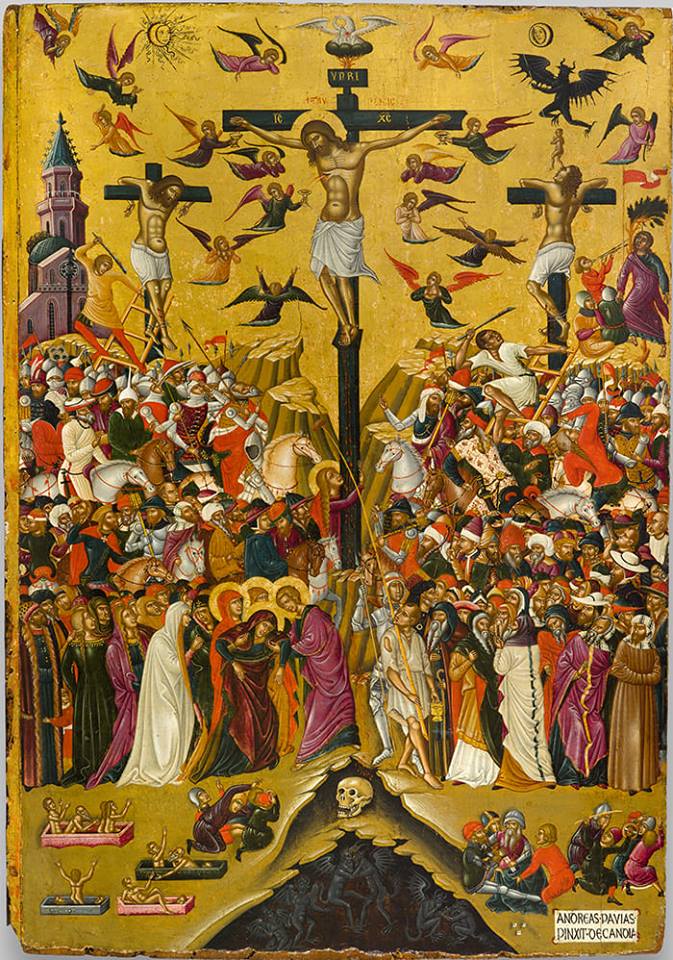
The Theotokos is the one in deep red at the foot of Christ and His cross being held up by other people. This woman can literally not stand on her own from pain. I love this icon because it shows the hectic and crazed mob that surrounded Christ that day. Thanks to Patristic Nectar Publications for this icon
My favorite hymn, hands down, no questions asked, is The Angel Cried which we begin singing Pascha (Easter) night, so Saturday night. It’s so great that I’ve gotten into a full blown yelling match with my one Orthodox boyfriend over it because he *didn’t* like it. (Big red flag, folks! We obviously didn’t make it very far.) He said it was “too emotional.” Well, Christ cried tears of blood, threw over the tables in the temple, wept tears for Lazarus, and cried in despair on the cross, so I think our emotions have been sanctified along with the rest of our humanity when God became man.
The Angel cried to the lady full of grace
Rejoice, rejoice, O pure Virgin,
Again, I say, Rejoice!
Your son is risen from His three days in the tomb.
With Himself He has raised all the dead,
Rejoice all you people!
Shine, shine, shine, O new Jerusalem,
The glory of the Lord has shown on you.
Exalt now, exalt now O Zion,
Be radiant O pure Theotokos in the resurrection
The resurrection of your son.
I’d add a recording, but sorry, I’ve never heard one that does it justice. No one sings it the way I think it should be sung, and I think this post has something to do with that:
We get to tell Mary, ‘your son is alive.’ Not only her son, but her God. Not that He survived a bad accident, but that He was dead, like legit dead, and now he’s alive. We get to tell Mary that He’s not only alive, but that He conquered death, ending Hades rule over us. You may not have the chance to hold a mother in your arms when you tell her her son survived a lightning strike’s amount of electricity through his body, but you have the chance to tell another mother. “Again, I say, Rejoice!”
 Petrichor